

Bringing a world to life
Published by James on 30/04/2026Hey Kinoko fans!
It’s been a couple of months since our last proper update. At the end of last month I, quite lazily, determined that my announcement about our change of domain name had already sufficed for the purposes of meeting my ‘one post a month’ quota, and so treated myself to a night off instead. What this means for you is that we’ve got even more to share this month, so buckle up and let’s get into it already.
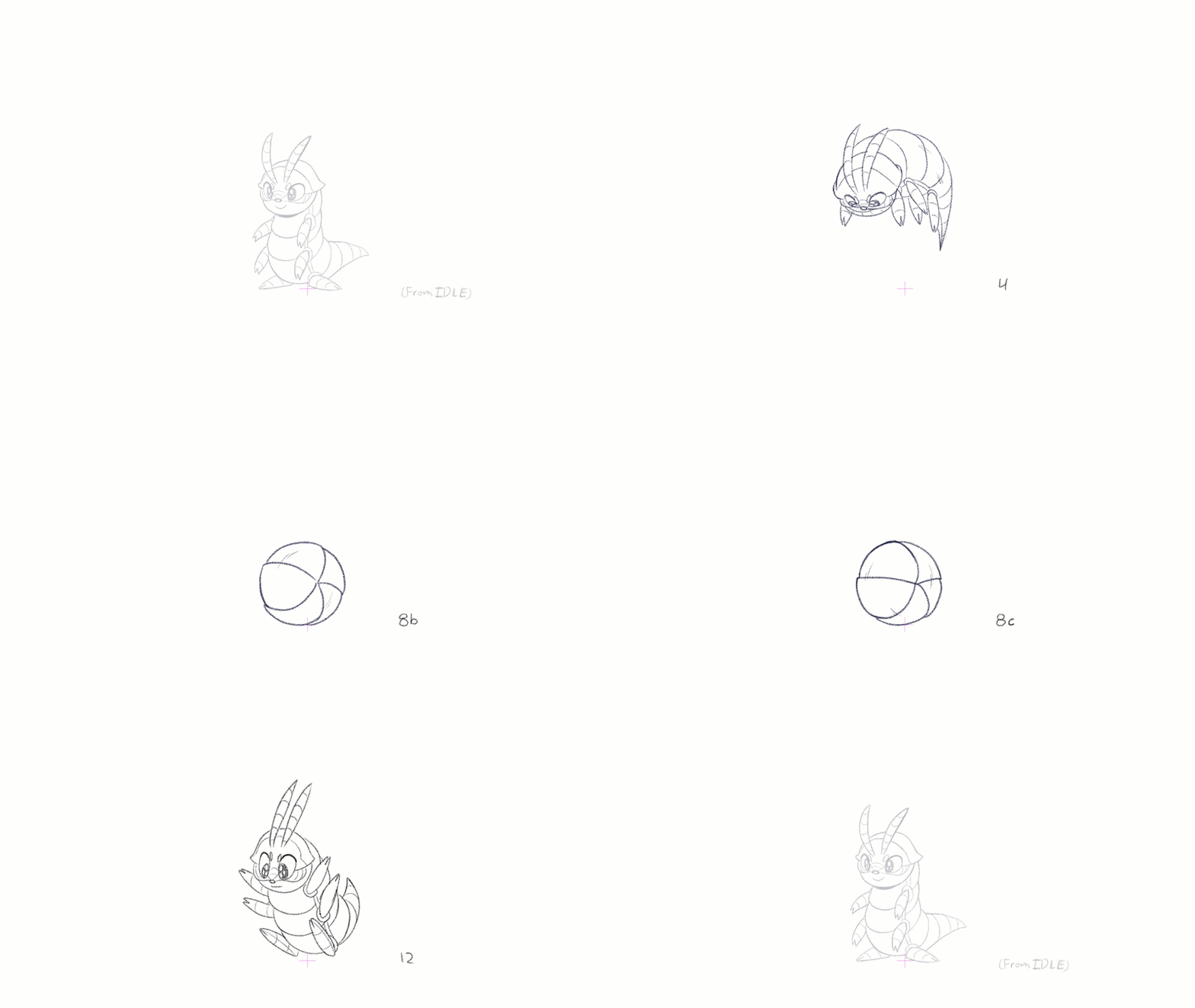
If you’ve been following the development of Star Heretic, you’ll perhaps know already that we’ve recently begun employing the services of the exceptionally talented AtroxChobatsu for some of our game’s animations. Atrox’s extensive portfolio to date includes animation work on Skullgirls, Sonic Mania, Smiling Friends and more, and so far Chel has worked alongside Atrox on several of Star Heretic’s enemies. To say that we’re delighted with how those are going would be an understatement – although I still need to finish developing these new enemies, visually they look amazing, and I can’t wait to get them working and fightable in-game. Atrox has produced roughs for several Fungaian dangers so far including sleepycaps, mycopods and bellarinas, and is currently producing roughs for fangflowers. Chel, meanwhile, is cleaning them up and colouring them.
As all of this has been going on, I’ve been busy making improvements to enemies too. I recently changed my mind on enemy health bars again, and have restored floating health bars above enemy’s heads for what is hopefully the last time! Kinoko’s moves (which themselves have been improved with the dropping in of some of Chel’s own unfinished animation work) now have greater visual impact than ever before, with most enemies being vulnerable to knockback and other status effects, and I’ve begun trying to develop better combat mechanics for enemy crowding situations, which I believe will be frequent in Star Heretic. Couple that with some of the game’s new visual effects we’ve had commissioned, and the game is looking better now than it ever has!
Something really nice that I had the opportunity to work on this month was the improvement of the starsprites’ movement logic. Behind the scenes, each starsprite basically has an invisible anchor that can move around the scene freely, usually sticking close to Kinoko but occasionally moving off elsewhere. When this anchor moves, unseen to the player, its starsprite makes a beeline for it, thus moving to a new position. Starsprites used to make this movement in a straight line from A to B, from their anchor’s old position to the new. Now, I’ve managed to make it so that starsprites move in a more life-like fashion. They vary their speed as they fly about, now, and they travel in curved or wobbly lines rather than straight ones. The coloured trails that they leave behind as they fly have also been redeveloped. I’m not quite ready to show these changes off yet, because I want to improve some of their abilities first, but I can’t wait for you to see everything that’s changed.
I’ve also made some essential performance-based improvements to the game. Multifactor antialiasing is now available via the game’s options, and I’ve finally had cause to implement the game’s first ‘loading screen’, which is in fact just a black screen that fades in and out between scenes. I always wondered when I’d have to think about loading, but just recently I noticed that the game had begun to ‘lag’ for a few frames here and there when warping into certain, asset-heavy scenes or casting abilities that trigger certain visual effects. The game now pre-loads these things as the game loads or as the specific scene loads, preventing the flicker of latency that would otherwise appear as the game attempts to load them during gameplay.
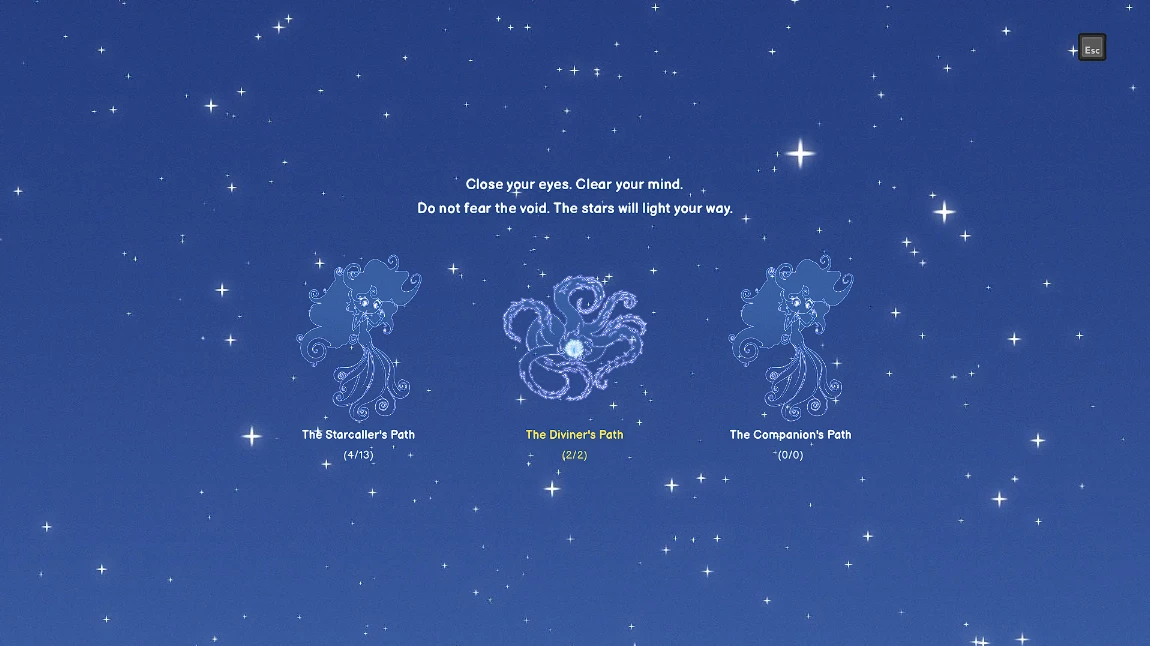
Another major thing that I got to spend more time developing this month was Kinoko’s skill tree. We haven’t actually come up with a list of skills for Kinoko yet, and we feel we’re still quite some way off being able to do so, so it’s mostly a prototype. There are, however, a few things we’re pretty certain about. Firstly, we don’t plan for any of the skills to be physically Kinoko’s own. Take the ever-popular ‘double jump’ for instance. Many metroidvania-style games will include this as an unlockable skill. If we also decide to offer a double jump, it won’t be Kinoko himself learning to do it – it’ll be his starsprites giving him a handy boost up. Secondly, we plan to split the unlockable skills into three categories, which I have named the path of the starcaller, the path of the diviner, and the path of the companion. Thirdly, you’ll be visiting the Temple of the Chime to unlock them.
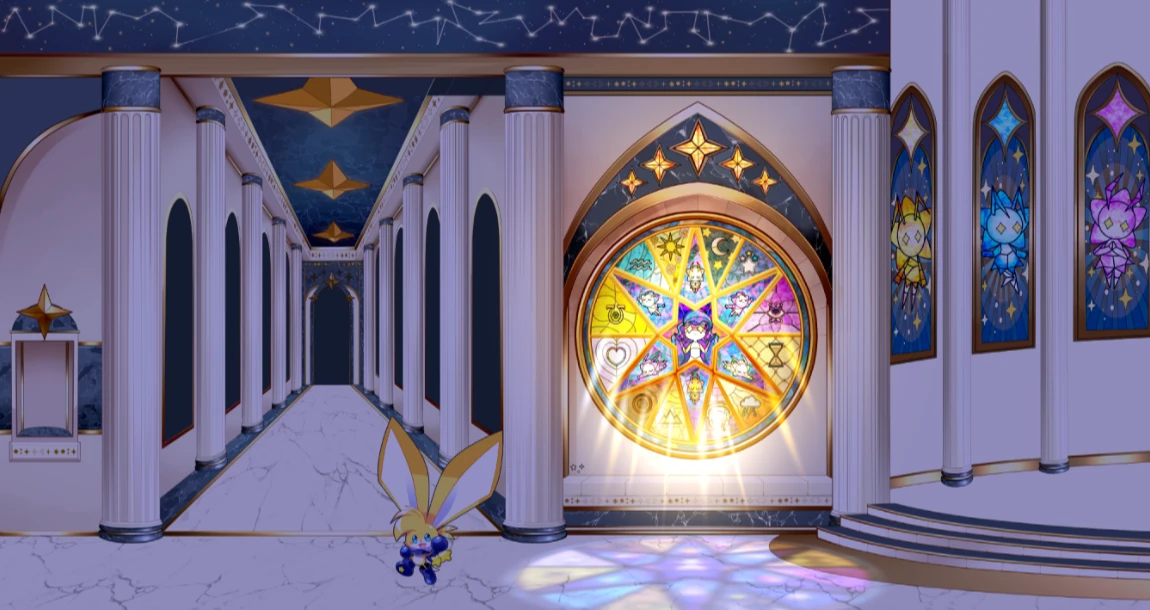
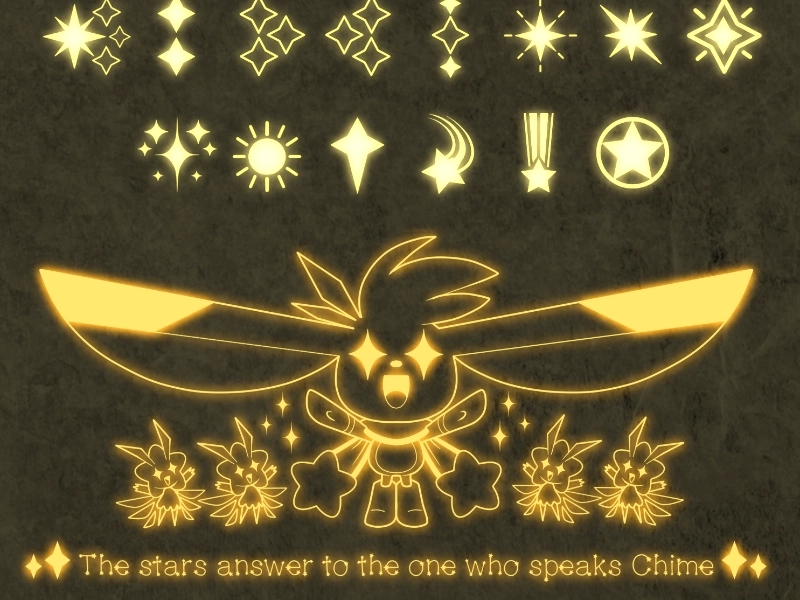
The Temple of the Chime, if you don’t know, is a very important location for Kinoko on his travels in outer space and his journey of self-discovery. Located in the Jungle of Whispers, a shadowy sector of planet Izelmyst’s ancient rainforests which themselves are shrouded in mystery, the Temple of the Chime was built long ago by sorcimur mages to house the Celestial Bells, a chorus of crystalline instruments, crafted to call upon the starsprites in their own tongue: Chime, the language of Galaxy and her children. It’s to this ancient temple that Kinoko must travel, if he is to harness his strange gift and learn to speak with his starsprite friends.
On that note, Chel’s been hard at work with continuing to bring Star Heretic’s version of the Temple of the Chime to life. Since it’s a unique interior space, vastly different from anything else that will be visited in Star Heretic, it’s turned out to be a great location for trying out different kinds of visual and lighting effects. The exact feel and tone of the place are things she’s still trying to work out. We want it to feel very atmospheric, sort of ancient and dusty, like it hasn’t been stepped inside in centuries, yet it feels as if the walls have eyes and as if some great power still resonates there. To achieve this, we’ve been investigating many of the visual tools at our disposal, such as lights and shadows, occluders, and particle effects. Just today, I developed the ability for certain scenes such as this one to produce an echo. We can’t wait to show off the results.
Something we’re still working really hard on trying to get right is Star Heretic’s combat. For all my months of trying, I do believe that I’ve finally come up with a good system for juggling up to eight different starsprites each with their own four abilities in addition to Kinoko’s own personal moveset. It’s something that I’ve redesigned and redeveloped so many times over the past year or so, never being quite happy with the outcome, but this time I really do think I’ve cracked it. Of course, it’s player feedback that will truly tell, but at least I think I’m done tinkering with it until our next playable demo. Now that it’s finally more intuitive for the player to cast the starsprites’ many abilities, the next thing we’ve got to do is make those abilities exciting, impactful and worthwhile. I’ve been making improvements to the casting bit – just yesterday, I changed it so that Kinoko is no longer forced to stop moving when casting, but can now continue to walk, run, or even sprint – but now it’s the abilities themselves that need work.
I mentioned in our last proper update that each colour of starsprite now has exactly four abilities, comprising one projectile, one area of effect, one utility, and one ‘ultimate’, and that these are based thematically around that starsprite’s speciality. Red starsprites, for instance, are the hot-headed attackers, and so their abilities are based around fire and raw enemy destruction, so expect to see fireballs and explosions with them. Blue starsprites, meanwhile, are the calm and capable defenders, whose abilities will provide Kinoko with parries and protection. With eight colours in total, we have 36 abilities in all to come up with, and there’s a lot of scope. As we continue to come up with the full arsenal of abilities – ideas are not in short supply, the difficult bit is coming up with ones the player will actually use! – we’re focusing on actually developing the ones for the colours that will appear in our next playable release: yellows, blues, reds, and if there’s time, greens.
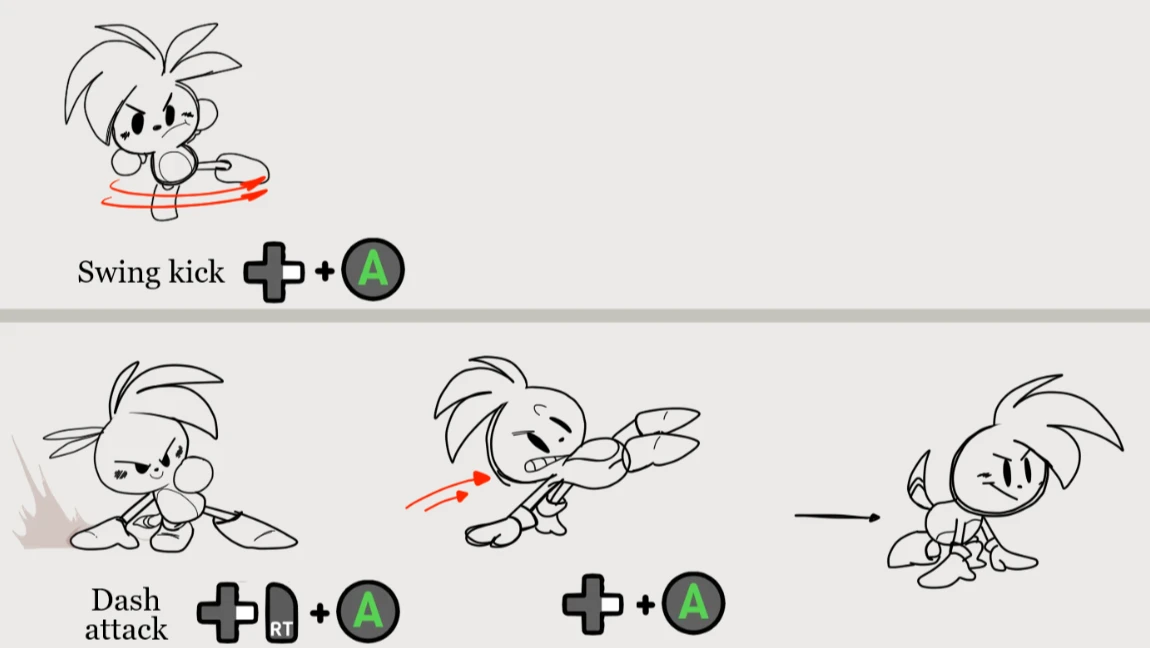
As I focus mainly on these abilities, Chel has just recently turned her attention back to Kinoko’s own core moveset. There’s a delicate balance that we’re trying to strike with Star Heretic. On the one hand, we want the player to make plenty of use of their starsprite companions and enjoy using their abilities; on the other hand, we don’t want them to neglect Kinoko’s own moves just because the starsprites’ moves are more impressive! What we’d ultimately like is not for the player to feel like the starsprites are fighting for Kinoko, but that they are fighting alongside him. How we hope to do that is by making Kinoko’s own moveset worth using, and then further by balancing that moveset alongside things like cooldowns and carefully-calculated starlight costs for each of the starsprites’ abilities. As balance on the whole isn’t something we’ve really spent too much time on, though, that’s another topic for another day!
As always, the ongoing development of Star Heretic’s mythology has continued to be a priority for both Chel and I. When it comes to writing, I personally subscribe to the view that no amount of worldbuilding is ever ‘too much’ for any work of fiction and that none of it need ever go to waste. For instance, even if Star Heretic the game only winds up scratching the surface of everything we’ve developed in the background, the world that the player does get to see will still be all the richer for it. Thus, I’ve been continuing to fill up our personal stash of lore on all manner of topics. Particular topics of focus recently have been the Enoki tribe and village, the background of Galactic Halo’s former leader Cassiopeia, and the sinister business of Event Horizon’s dark prophet Necronyx. The Enoki village actually has a rough map now, for the first time ever; I had the idea of basing the village on a natural fairy ring structure, with a river flowing through from west to east and an eyot in the centre, where the ancient mycelium beneath the earth was too tough for the water to cut through, and so had to go around, leaving an ‘island’ plaza for the tribespeople’s festival and gathering space.
Out of that worldbuilding have come additional strides in the writing of Star Heretic’s plot. I’ve had a vague idea, a sort of three-act structure set over five distinct chapters, for the game’s plot for some time now. Knowing more about our universe and what’s happening in it, particularly with the story’s central cults, Galactic Halo and Event Horizon, has helped me tremendously in shaping that plot into something that feels like it belongs in that universe, whilst also serving its purpose as a journey of self-discovery for Kinoko. Fortunately, we don’t have to make any concrete decisions just yet, but I feel very confident already about the path we’re on in this respect.
And speaking of plot, those who enjoyed our Star Heretic prequel comic, ‘The Birth, Rise and Fall of Galaxy’, will be pleased to learn that Chel has started work on the comic’s next chapter, currently titled ‘A Star is Born’. As with the prequel comic, there’s no set timeline for this, with Chel drawing it and I writing it only when the opportunity arises, but it’s intended to be analogous to Star Heretic the game, telling broadly the same story but in a different medium, and covering additional story angles that don’t fit into the game’s narrative. It won’t be essential reading for enjoying the game, but it’ll offer an even deeper dive into the world of Star Heretic for those who really enjoy following Kinoko’s story. I’m not sure when we’ll have an update on that, but know that it’s hopefully coming!
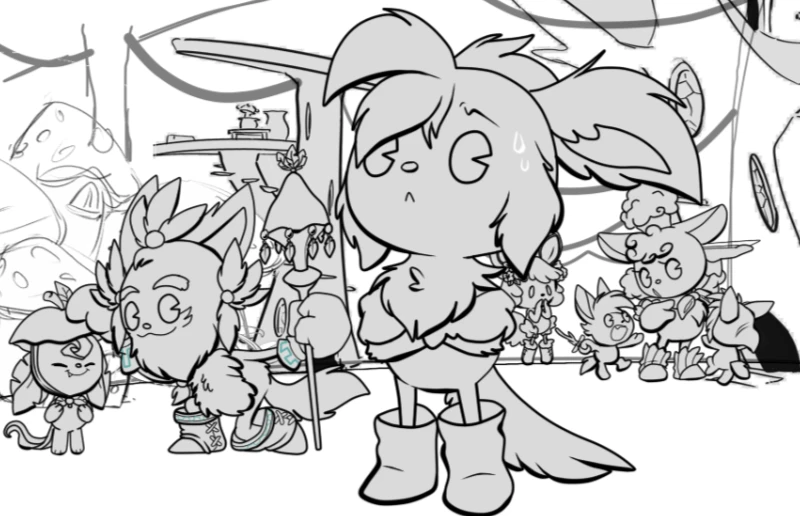
That’s about all I have to say on the topic of Star Heretic this month, although we do have one final, exciting bit of news to share on the topic of community. As you may already know, the Cult of Galaxy Discord server has long played host to regular roleplaying sessions on Drawpile, a collaborative drawing application where users can draw together on a shared canvas. Since Drawpile.net itself does not allow for persistent sessions, this used to mean that Chel or one of the other operators had to host and everyone else had to wait for them to do so, and so this month we took the initiative to launch our own Drawpile server, where there is now a persistent roleplaying board up and running 24 hours a day. If that’s something you might be interested in, make sure you check out the #drawpile channel in our Discord server.
As always, I’d just like to remind our readers once again that you can usually be the first to hear about everything we’ve been working on via Patreon, where you can subscribe and support our work for as little as one United States dollar per month. As we continue to work on starsprite abilities, level design, comics and more, we’ll have many, many more exciting updates to be found there and in our Patreon-exclusive #updates channel on Discord over the coming weeks.
And now, that really is all I have to say for another month. Until next time!
Latest posts
Since it’s the middle of summer, and since we’ve been in and out of heatwaves for the last few weeks here in England, Chel and I have both been taking the opportunity to go a little slower than usual throughout July. We’ve taken some time to ourselves, and hopefully staved off some of the burnout…
It’s been another busy month full of all kinds of new developments for Star Heretic, with many of them of a more visual nature. Our user interface has had its first beginnings of an uplift in well over a year and we’ve thrown in some placeholder, stock visual effects for abilities and their effects…
This month has been another interesting month for the development of Star Heretic, full of interesting new challenges. We implemented the mycopod enemy, with all its unique mechanics and kill conditions, and we developed more abilities for starsprites, including a few for the pink and purple ones…